

What years of trading taught me about the two minds inside a good investor
Adapted from the Podcast interview on The Derivative, in an episode titled, “Patrick Welton’s Journey from Stanford Oncologist to one of Trend Following’s Quiet Legends.”
Not long ago, an interviewer asked me a question I had never heard before.
I trained as both a physician and a scientist. For decades, I practiced and taught in Medicine and built a firm that hires PhDs. The interviewer’s question probed beyond simple background, focusing on a potential dichotomy. “Did those two kinds of minds ever come into conflict in the way I trade?”

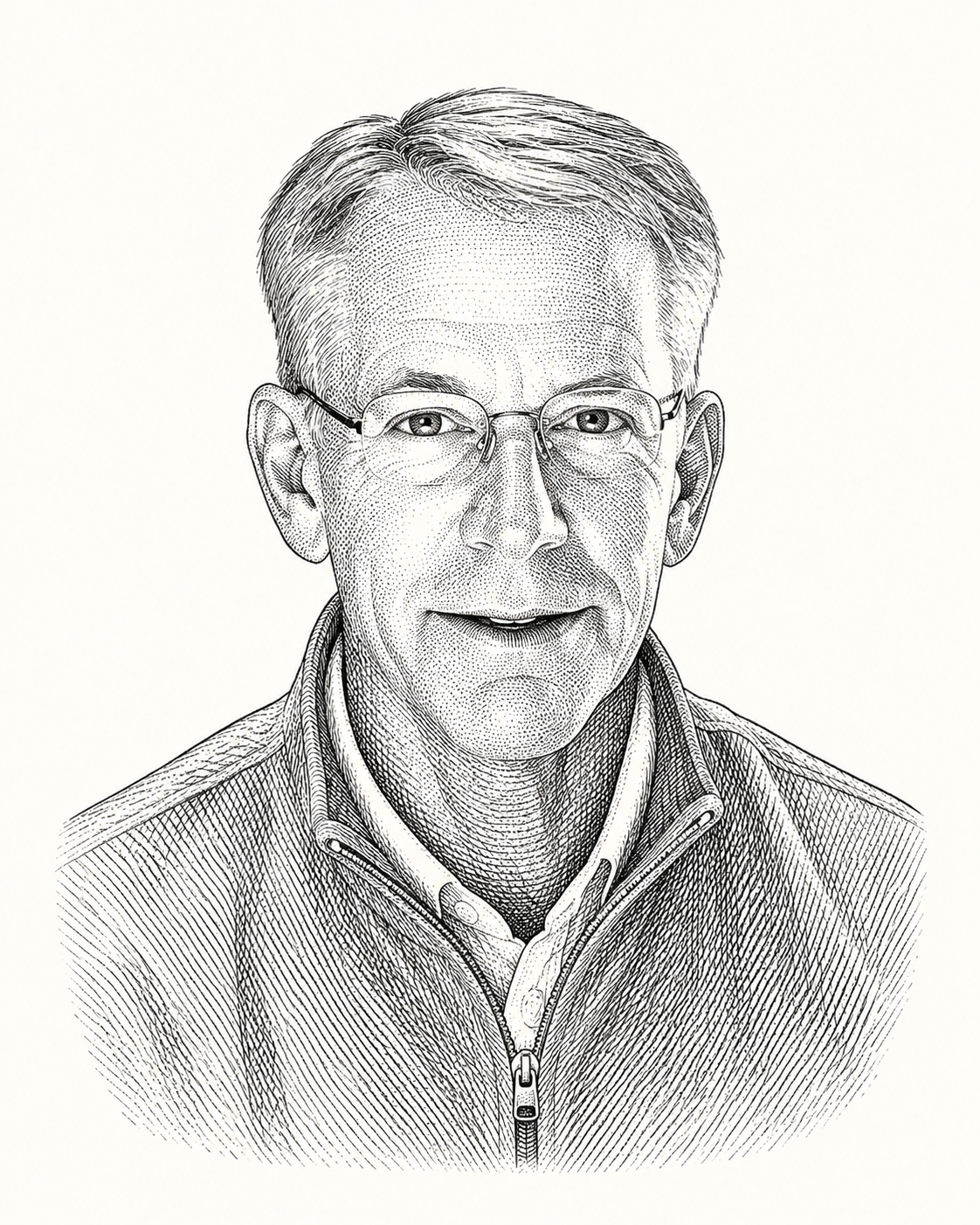
Dr. Patrick Welton in his library.
The question was insightful. And as I reflected upon it, I believe the answer is yes. They can conflict because they train to different strengths. They also each exhibit a weakness in how I think about trading.
A Foot on the Boat and a Foot on the Dock
For most of my working life, I have had one foot on a boat and one foot on the dock. The dock is the scientist. The boat is the physician. In this metaphor, some days the two are aligned and you stand comfortably. Some days they pull apart, and you have to commit to one or the other or you end up in the water.
I came to trading through both. I started trading futures in 1978, as a student, mostly out of need, tapping markets to cover tuition and rent. Later I trained as an MD-PhD, as an NIH grant medical scientist, left my Biophysics graduate work at my dissertation, pivoted to full-time clinical work, did a year with trauma and ICU teams, then more years as a resident and fellow, and then spent years on the Stanford clinical faculty in radiation oncology and building a comprehensive cancer center in Monterey.
“A scientist and a physician do not always think the same way. And once you see the difference clearly, you see it everywhere in trading.”
The trading and the medicine ran in parallel for decades. When our children were young and wondered about my leaving for work, I could relate to them, when “House” was on television, that their father was a little like Dr. House with his residents, minus the cane and the pills. When they asked about leaving for the trading business, there was no easy TV analogy for me to offer about working in front of powerful computers.
Running medicine and trading side by side for that long teaches you something you would not learn from either one alone. A scientist and a physician do not always think the same way. And once you see the difference clearly, you see it everywhere in trading.
Two Archetypes
Generalizations never fully work, so I want to take care to be instructive. We cannot say a medical doctor frames problems exclusively like this and a PhD pursues solutions exclusively like that. But we can create two simple archetypes that show us where the strengths and weaknesses that impact trading success emanate from, at least in my view as iron sharpens iron over forty-eight years in the markets.
Start with the science-based PhD. A scientist is principally an objectivist who pursues the reduction of uncertainty. Most people know this as the scientific method. But the scientific method rarely works in the way many commonly perceive. There is rarely any Eureka moment. The engine of research is focused, effort-driven iteration. Each cycle of a scientific discovery reduces uncertainty by a little and delivers a hypothesis-proven model a little more predictive than before. The work is the narrowing. A scientist is trained, year after year, to chase precision and to treat the reduction of uncertainty as the goal itself.
“There is rarely any Eureka moment. The engine of research is focused, effort-driven iteration.”
Contrast with the physician. A physician is more of an empathicist than an objectivist. While caring for a patient and hoping for the best outcome, a doctor almost never gets precision or even the comfort of certainty. What a doctor does, all day, is embrace consequential decisions despite uncertainty, in spite of what is incompletely known at that point in time, always with an uncomfortable awareness that much more is unknown, and then readjusts quickly as the priors change. A new symptom, a new test, a new response to treatment, and the assessment moves. A physician traverses a Bayesian landscape whenever they are taking care of a complicated patient through time, because a complicated patient never stops changing.
Hold those two archetypes side by side, and they tell you a great deal about trading.
The Trader’s Matrix
Put the two archetypes together and you get a trader’s matrix. I see myself in all four positions. So, I expect, can most people who trade.
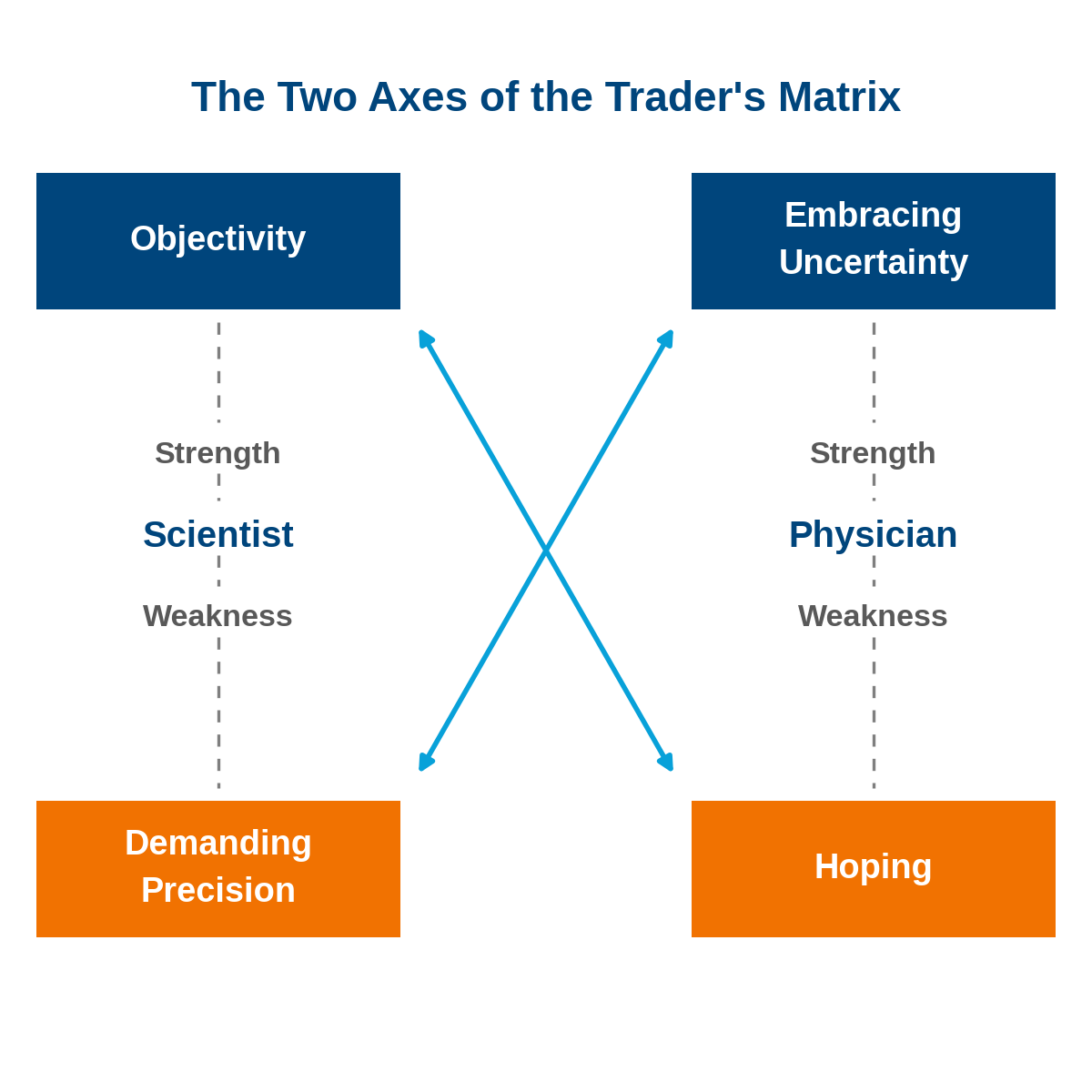
The matrix has two axes. One runs from objectivity to hoping. The other runs from embracing uncertainty to demanding precision. The scientist and the physician each bring a strength to one axis and a vulnerability to the other, which is why neither training, on its own, makes the most effective trader.
Start with the first axis. A major weakness of trading is hoping or caring for an outcome. The moment a trader starts to want the position to work, starts to root for it, judgment is compromised. The opposing strength is the scientist’s. Being objective is the axis of strength there. Take the information and the evidence as they actually arrive, not as you wish they would arrive. On this axis the trained scientist has the advantage. The trader who cannot get there will struggle no matter how much else they know.
Now the second axis. This one tethers many with formal scientific training to a major weakness as they approach markets. As prices changes through time, they often come to trading with an expectation of precision and prediction, the core of science. But they will never find it. The purist expectations of the science do not survive contact with a market.
I have watched this light bulb switch on, along with the frustration that accompanies it, many times with quants in my own firm and elsewhere. Someone arrives able to correctly calculate an answer to five or even fifty decimal places. Except longer-term trading and investing success isn’t about decimal places. The precision is decorative. Experienced traders often succeed by getting the integer and the sign right. Whether the thing goes up or down.
And that view turns out to be the easy part. Trading success and time are inseparable. As time moves forward, new information, new flows, new costs, new carries, new risks, new dependencies appear and disappear, ebb and flow, and fuel doubt with uncertainty.
The strength opposing this weakness is embedded in the MD. The training is as much a doctorate in embracing uncertainty under fire, changing as conditions change, never having complete information nor the comfort of certain prediction, as it is a degree in human disease or physiology. Like markets, medicine rarely has the luxury of certainty.
Now we can see the effective trader matrix in full through the MD and PhD archetypes:
- The scientist’s objectivity, a strength.
- The scientist’s expectations for precision, a weakness.
- The physician’s comfort with irreducible uncertainty, a strength.
- The physician’s hope for an outcome, a weakness
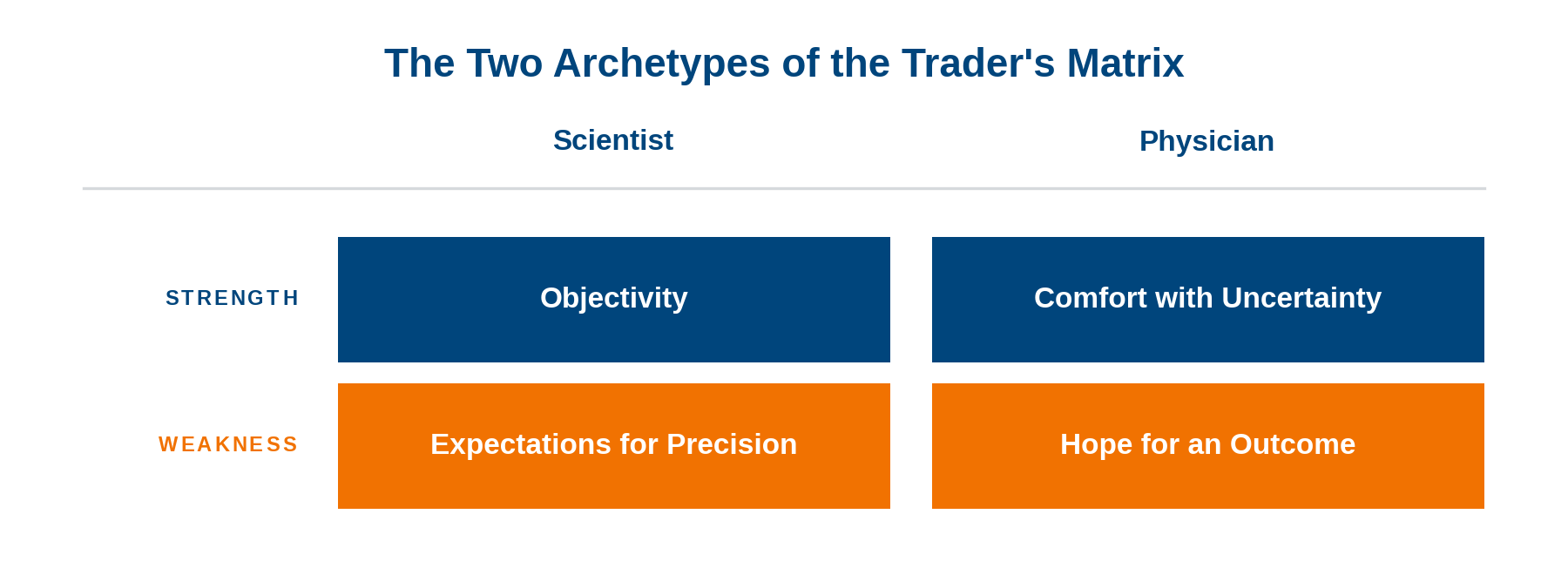
The work is knowing which box you are anchored in at any given moment. If there is ever a weakness, it is time to be more objective. And if there is ever another weakness, it’s time to be less prescriptive and more Bayesian and keep honing one’s edge to changing probabilities as they occur. Those are success pathways for a trader.
Why None of the Data Buys the Market
This is more than an abstraction about temperament. Understanding the temperaments changes how you read the market itself.
A young analyst often approaches the market with an unspoken assumption, and some older quants never let go of it. The assumption is that if you analyze enough data, the data will tell you how the market will respond. One variable or several million variables inside a model, the belief is the same. The implicit analytical assumption is that input data moves the market as though the linkage is direct and as though the linkage is invariant through time.
Regrettably, neither assumption is true or stable and for good reason. Markets move as money moves into liquidity and over time. None of the data in the world buys or sells anything.
Rather than a linkage, a more resilient view is like a three-body problem:
- There is the data on one side.
- There is the price on the other.
- And in between sits the third body, the market participants. That third body is the loose and variable joint in the whole system.
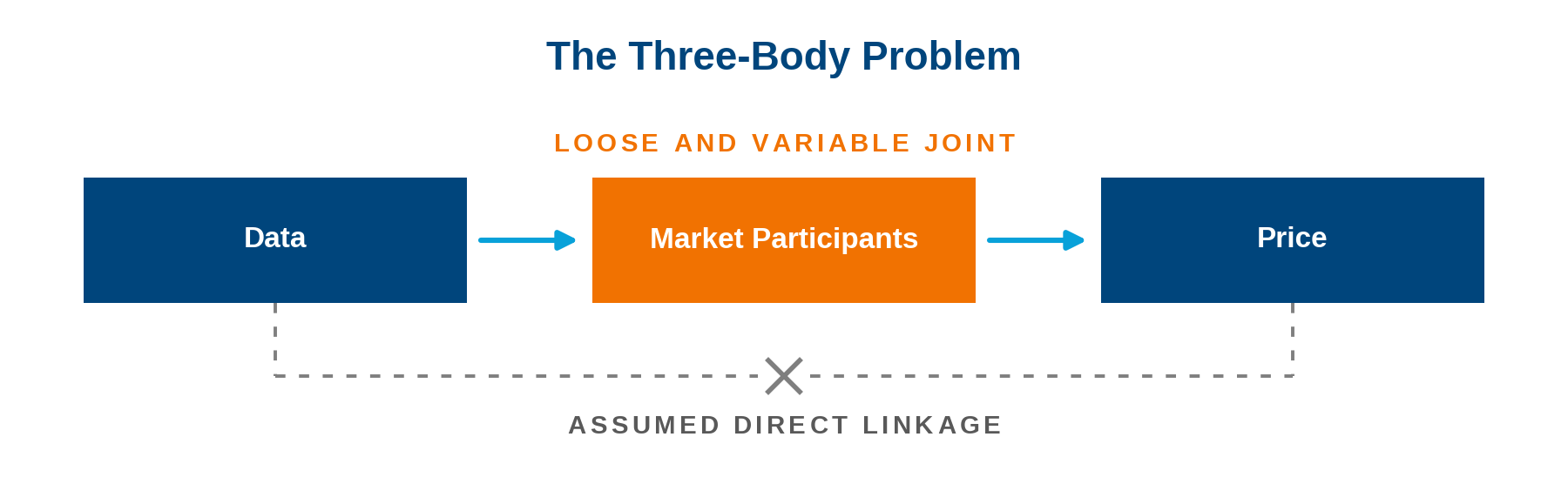
The data does not care what the price does. The price does not care what the data says. What matters is how the people or their agents, machine or otherwise, doing the buying and the selling are reacting to that data right now, this month, this year.
For years at a stretch, participants will focus on money supply, and then a stretch will come when they forget what it even is. The same report lands as a six-sigma shock the first time it appears, a three-sigma move the second time, and a one-sigma ripple the third. The data did not change. The participants’ reactivity did. Later, they will fix on unemployment, and then stop, or their perceptions of value before replacing them with new perceptions of value.
When commentators say a regime has changed, what has really changed is the way the third body is reacting to the information flowing past it.
“The data did not change. The participants’ reactivity did.”
A scientist’s instinct is to model the link from data to price directly, because that link should be precise and stable. A physician’s instinct is to assume the patient in the middle is alive, reactive, and never quite the same patient twice. The market is the patient.
What I Am Still Doing About It
While simplistic, the archetypes are a useful parable for improving our success in markets. We are better traders when we are more objective. And we are better traders when we are more Bayesian. We must keep choosing both. And we must understand that as conditions change objectively, we must adapt and change our view.
It took me a great many years to simplify this into language this plain.
What the framework taught me was also how to mentor. When a gifted quant joins us, the math is rarely the problem. The math is usually excellent. What I can offer, after forty-eight years, is the balance. I can show them how the precision they were trained to prize can become a liability, and how the pathway of discomfort they were trained to eliminate becomes the trading edge.
Returning to the image of straddling the dock and the boat, the dock taught me to be objective and grounded about the evidence. The boat taught me to act and to keep adapting my balance as the water moved. A trader benefits from both. Most of the difficulty, and most of the opportunity, is in learning when to shift your weight, and when to jump.
THE OPINIONS EXPRESSED ARE THOSE OF THE AUTHOR OR THE INDIVIDUAL TO WHOM THE STATEMENTS ARE ATTRIBUTED. WHILE BELIEVED TO BE REASONABLY BASED ON FACT AND INQUIRY, THERE CAN BE NO GUARANTEES THAT SUCH OUTCOMES EXPRESSED OR IMPLIED HAVE OCCURRED OR WILL INDEED OCCUR.
THIS DOCUMENT IS NOT A SOLICITATION FOR INVESTMENT. SUCH INVESTMENT IS ONLY OFFERED ON THE BASIS OF INFORMATION AND REPRESENTATIONS MADE IN THE APPROPRIATE OFFERING DOCUMENTATION. ANY INVESTMENT PROGRAM DESCRIBED HEREIN IS SPECULATIVE, INVOLVES SUBSTANTIAL RISK AND IS NOT SUITABLE FOR ALL INVESTORS. NO REPRESENTATION IS BEING MADE THAT ANY INVESTOR WILL OR IS LIKELY TO ACHIEVE SIMILAR RESULTS. PAST PERFORMANCE IS NOT NECESSARILY INDICATIVE OF FUTURE RESULTS.